
 Image 1 of 1
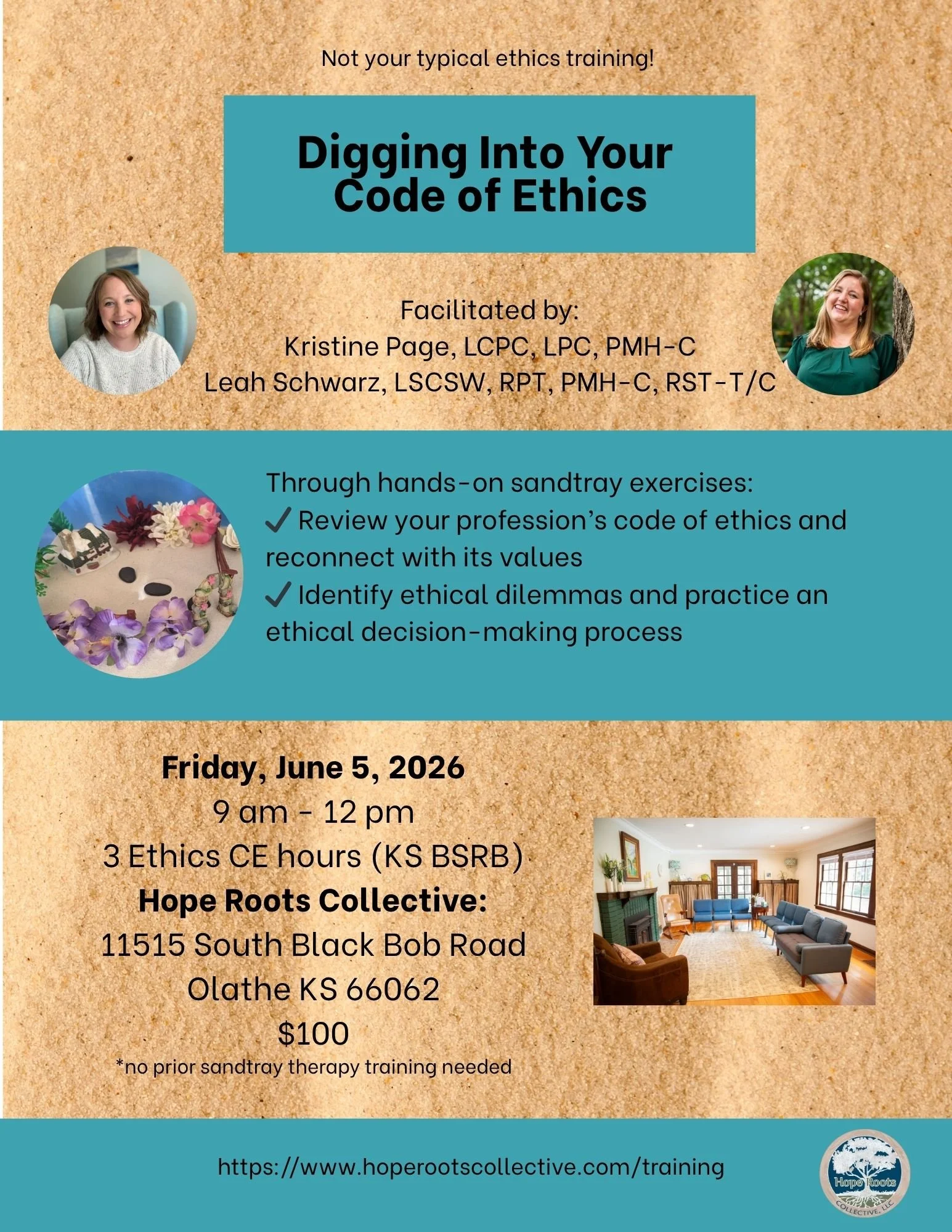
Digging into Your Code of Ethics
Friday, June 5
9 am - 12 pm
3 Ethics CEUs for mental health professionals
This is not your typical ethics training!
Let’s take a deeper and hands-on dive into the Code of Ethics. In this training, spend time reviewing your profession’s code of ethics (social work, counseling, or marriage and family therapy) and connect with it on a deeper level through sandtray directives. Re-center and connect with the core values that brought you to this profession. Identify common ethical dilemmas and work through an ethical decision making model. Discuss the diversity of approaches and techniques in the profession and differentiate between something being “unethical” vs. just a different approach.
Training is appropriate for mental health graduate students and licensed mental health therapists. No prior sandtray therapy training or experience needed.
Objectives:
Analyze your profession’s code of ethics (social work, counseling, marriage and family therapy) and reconnect with its core values through reflective and experiential sandtray activities.
Identity common ethical dilemmas in practice and apply an ethical decision-making model. Work through the decision-making process in the sandtray.
Differentiate between unethical practices and ethically appropriate variations in therapeutic approaches, with attention to diversity in clinical techniques and perspectives.
About the presenters:
Kristine Page, LCPC, LPC, PMH-C, is a therapist and the owner of Turning The Page, LLC, a private practice based in Olathe, Kansas. She has over 14 years of experience working with individuals across the lifespan. Kristine began her career in community mental health and at a child advocacy center, where she specialized in working with children and teens. During this time, she developed a strong foundation in play therapy and sandtray therapy, supporting children and families in processing complex experiences.
Over the past six years, Kristine has transitioned her focus to the perinatal period, where she supports individuals navigating pregnancy, postpartum, and identity shifts into parenthood. In her work with the perinatal population, she continues to integrate sandtray therapy with adults, creating space to explore trauma, identity, and personal values in a meaningful and experiential way.
Leah Schwarz, LSCSW, RPT, PMH-C, RST-C/T is a bilingual (English/Spanish) therapist and owner of Hope Esperanza Counseling LLC. She has over 12 years of experience as a social worker, working in community mental health, a domestic violence agency, and now in private practice. The first part of Leah’s career centered around working with children and families, and in recent years she has pivoted to specializing in perinatal mental health, supporting new and expecting parents. Leah is trained in EMDR and loves using sandtray therapy with clients of all ages. Leah also co-owns Hope Roots Collective in Olathe, KS - a wellness collective focused on incorporating nature into healing, supporting therapists in building practices aligned with their values, and reducing burnout among providers.
Friday, June 5
9 am - 12 pm
3 Ethics CEUs for mental health professionals
This is not your typical ethics training!
Let’s take a deeper and hands-on dive into the Code of Ethics. In this training, spend time reviewing your profession’s code of ethics (social work, counseling, or marriage and family therapy) and connect with it on a deeper level through sandtray directives. Re-center and connect with the core values that brought you to this profession. Identify common ethical dilemmas and work through an ethical decision making model. Discuss the diversity of approaches and techniques in the profession and differentiate between something being “unethical” vs. just a different approach.
Training is appropriate for mental health graduate students and licensed mental health therapists. No prior sandtray therapy training or experience needed.
Objectives:
Analyze your profession’s code of ethics (social work, counseling, marriage and family therapy) and reconnect with its core values through reflective and experiential sandtray activities.
Identity common ethical dilemmas in practice and apply an ethical decision-making model. Work through the decision-making process in the sandtray.
Differentiate between unethical practices and ethically appropriate variations in therapeutic approaches, with attention to diversity in clinical techniques and perspectives.
About the presenters:
Kristine Page, LCPC, LPC, PMH-C, is a therapist and the owner of Turning The Page, LLC, a private practice based in Olathe, Kansas. She has over 14 years of experience working with individuals across the lifespan. Kristine began her career in community mental health and at a child advocacy center, where she specialized in working with children and teens. During this time, she developed a strong foundation in play therapy and sandtray therapy, supporting children and families in processing complex experiences.
Over the past six years, Kristine has transitioned her focus to the perinatal period, where she supports individuals navigating pregnancy, postpartum, and identity shifts into parenthood. In her work with the perinatal population, she continues to integrate sandtray therapy with adults, creating space to explore trauma, identity, and personal values in a meaningful and experiential way.
Leah Schwarz, LSCSW, RPT, PMH-C, RST-C/T is a bilingual (English/Spanish) therapist and owner of Hope Esperanza Counseling LLC. She has over 12 years of experience as a social worker, working in community mental health, a domestic violence agency, and now in private practice. The first part of Leah’s career centered around working with children and families, and in recent years she has pivoted to specializing in perinatal mental health, supporting new and expecting parents. Leah is trained in EMDR and loves using sandtray therapy with clients of all ages. Leah also co-owns Hope Roots Collective in Olathe, KS - a wellness collective focused on incorporating nature into healing, supporting therapists in building practices aligned with their values, and reducing burnout among providers.